

























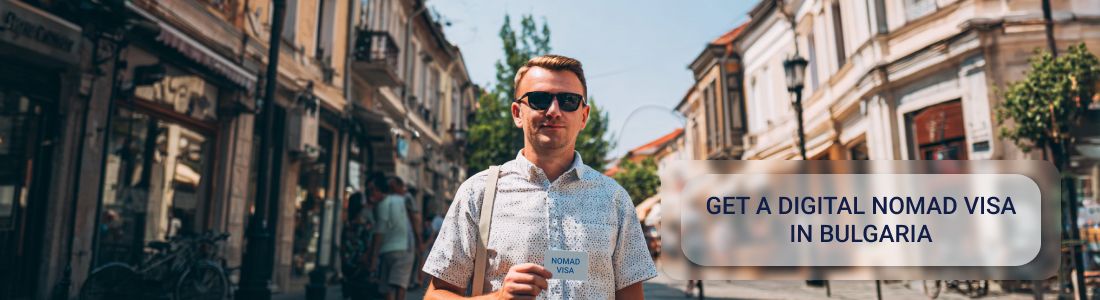



When Bulgaria partially joined the Schengen area in spring 2024, it passed an important milestone in its European integration and, in the same move, unlocked fresh prospects for cross-border business. Easier passage across its sea and air borders sharpened the country's pull as a base for freelancers and startup founders who treat the EU as a strategic arena for scaling their ventures. A visa for digital nomads has been rolled out here from 2025; yet, capped at half a year, it trails the longer-running European schemes such as those running in Spain or Hungary.
What I set out below is my own reading of the current legislative amendments touching immigration schemes for digital nomads. I will walk through how to obtain a Digital Nomad visa in Bulgaria and lay out the criteria that decide eligibility.
Changes to the Digital Nomad Visa programme in Bulgaria
Migration law in the country has been made stricter: on 17 April 2025 the National Assembly gave first-reading approval to a weighty set of amendments to the Law on Foreigners. Driving the reform is the country's readiness for full Schengen membership, together with the task of bringing domestic rules into line with the shared European control standards. What I do below is unpack the new legislative initiatives point by point and weigh how they could reshape the legal landscape for foreign residents and would-be migrants.
Anyone hoping to obtain a residence permit in Bulgaria under the Digital Nomad scheme has to clear several conditions that vouch for financial soundness and for the legality of the professional work. To start with, proof is needed of a steady average monthly income across the year equal to 50 minimum monthly wages in Bulgaria — a bar that this year works out at 53,850 Bulgarian leva (roughly 27,535 euros). On top of that, the personal account has to carry a balance matching no fewer than 12 minimum wages, which vouches for the applicant's means throughout the stay in the country.
The mandatory requirements for a digital nomad visa in Bulgaria also take in residential property on Bulgarian soil — owned outright, or backed by evidence of a rental — alongside a live insurance policy. Measures of this sort exist to safeguard the social protection of digital nomads and to trim the administrative risks carried by the Bulgarian state.
Money, though, is only half the picture. An applicant has to fit one of the professional-activity criteria written into the law. The opening route is remote employment under a labour contract with a firm incorporated beyond the EU, the European Economic Area or Switzerland, where the employee delivers work at a distance, chiefly in IT. Should that contract be fixed-term, its lifespan has to match or run past the residence permit being sought.
A second path to obtain a Digital Nomad Visa in Bulgaria opens for the owner or director of a company registered outside the EU, EEA or Switzerland; here the applicant needs a capital stake above 25% or a seat among the company's governing bodies. The third path covers IT services rendered in a personal capacity as an individual. On this track the applicant has to show that, for no less than a year ahead of filing, the professional services were carried out remotely from beyond Bulgaria and drew on no clients inside it. Nor may that person hold freelancer registration in Bulgaria or serve local customers. Framed this way, a Bulgarian visa for digital nomads stays within reach of self-employed specialists while shielding the national economy from unfair competition.
Who the Digital Nomad Visa in Bulgaria Is Intended For
The digital nomad visa in Bulgaria speaks to a specific band of specialists and entrepreneurs whose living comes from remote work and who need not sit in one office or one country. First in line are freelancers and remote staff — people who either partner with foreign firms or supply their own services online. Mobility and a schedule of their own choosing are what such specialists prize, unbound as they are to any single spot; obtaining a digital nomad visa in Bulgaria hands them a lawful footing to remain in the country for six months.
The same visa category fits digital entrepreneurs just as well — those steering online projects or companies that earn steadily wherever their operator happens to be. Into this group fall owners of web stores, software engineers, marketers, consultants and other professionals whose workflows and revenue run through the global network. For them the visa doubles as a lever for widening investment options and for settling comfortably in a new country, no work permit required.
EU residents already come and go and settle in Bulgaria free of any extra visa steps; by contrast, securing a residence permit in Bulgaria through the Digital Nomad Visa is the route for nationals of the Americas, Asia, Africa and Oceania who want lawful, long-haul residence in Bulgaria while keeping their remote work going. That split lets the state keep a hand on migration flows and, at once, draw in skilled specialists and higher-earning entrepreneurs.
How to Obtain a Digital Nomad Visa in Bulgaria: Conditions and Procedure
Arranging a digital nomad visa in Bulgaria calls for documentary proof of two things at once: that the professional work is genuinely remote, and that a steady income is coming in that can bankroll life in the country. Confirmed remote earnings sit at the heart of obtaining a digital nomad visa in Bulgaria, since they let the applicant fund the local stay unaided. In practice that means evidencing a regular monthly wage broad enough to meet every living cost — an approach that assures Bulgaria's migration authorities the foreign resident will lean on neither local welfare nor local employers.
Whoever means to arrange a digital nomad visa in Bulgaria must, without fail, show the work is performed off Bulgarian soil, and the supporting paperwork has to follow: a labour contract with a foreign employer, agreements for freelance assignments, or other proof of ties to enterprises abroad. Among the pivotal papers for a Digital Nomad visa in Bulgaria is the passport itself — its validity has to reach more than six months past the close of the stay you have in mind.
Obtaining a Digital Nomad Visa in Bulgaria: Requirements for Documents
The file opens with the visa form, and everything on it has to be exact, up to date and signed by the applicant's own hand; a slip or a blank can trigger refusal or force a fresh submission. A copy of the foreign passport comes next, with close scrutiny reserved for the legibility of the personal details, the photo and the validity dates already flagged above.
Proof of financial standing is a fixture of the bundle. Six months of bank statements that lay out a dependable income answer the purpose here, and freelancers do well to add contracts with foreign clients or invoices for finished jobs. Papers of this kind persuade the authorities that a real remote income exists and that no Bulgarian job is on the applicant's mind.
A current international-standard medical policy is likewise expected — one that spans the whole stay and spells out the risks it covers, with emergency care singled out for particular notice; rendering it into Bulgarian tends to shorten the review. A police clearance certificate ranks as another compulsory item, drawn from the country of permanent residence or citizenship, translated into Bulgarian and, in certain cases, carrying an apostille to vouch for its authenticity.
Optionally, the applicant can enclose a covering letter that gives the reasons for the move to Bulgaria. It is not compulsory, yet it can tip things favourably; a few lines on the nature of the work, the pull of Bulgaria and the plans for the stay usually suffice. Two passport-size photographs are also due, cut to the standards set by Bulgarian missions abroad. Rounding off the list is proof that the visa fee has been paid — a receipt or some equivalent slip from the competent body.
Advantages of the Digital Nomad Visa in Bulgaria
Several upsides come with arranging a digital nomad visa in Bulgaria. For a start, few EU states match it on affordability. Sitting where the Balkans meet the Mediterranean, the country draws digital nomads, travellers and expats keen to sample the region's deep culture and its neighbours without burning much time or money. Full membership of the Schengen area, once achieved, threw open easy access to bordering states — Romania, Greece, Serbia and Turkey.
Low living costs are a hallmark of Bulgaria, which counts for a great deal when a long stay is on the cards. Sofia, Plovdiv and Varna serve up affordable prices, solid infrastructure, dependable internet and a swelling international crowd. On top of that, the digital nomad visa in Bulgaria opens the door to a personal identification number that smooths administrative errands no end — with it a bank account goes up fast, a tenancy agreement gets signed, and the healthcare system comes within reach, all of which lightens daily life and frees attention for work and personal aims.
Contact our specialists
Legal Support in the Process of Obtaining a Digital Nomad Visa in Bulgaria
There is nothing light about the process of obtaining a digital nomad visa in Bulgaria; it runs through a thicket of formalities — assembling the document bundle, evidencing financial standing, proving a remote income stream and squaring up to the other set conditions. Given how tangled the legislation can get and how readily a mishandled file draws a refusal, leaning on qualified legal help is the sensible way to clear every stage cleanly and on time. Professional lawyers:
- assemble and vet the complete document bundle before it is filed;
- guide the applicant through income proof and the insurance requirements;
- stand alongside at every point of contact with the migration authorities;
- keep the file within all legislative norms, which pares back the risk of refusal.
Picking the right legal backing weighs heavily for anyone set on obtaining digital nomad status in Bulgaria. Seasoned specialists can steer the whole undertaking with local statute and its finer points in view — a point that bites hardest for those eyeing a long stay or a place inside the Bulgarian business scene.
Alternatives to the Bulgarian Digital Nomad Visa in European Countries
A cluster of EU states have already stood up dedicated visas and residence titles that let foreigners pursue remote professional work while based somewhere comfortable. Hungary's White Card counts among the more reachable of them, open to remote specialists on a steady foreign income who hold no Hungarian job.
The White Card in Hungary confers a stay of up to one year, its renewal opening six months on from the lapse of the current permit. On the money side the monthly floor is set at EUR 3,000. Processing spans roughly six to eight weeks; the applicant is then handed a window of thirty days in which to enter and file for residence, so the whole cycle runs to four or five months. Moving with relatives, though, the scheme does not allow, and an absence from Hungary exceeding ninety days over a single year may cost the holder the permit.
A freelancer visa good for a two-year term, renewal permitted, is what Greece has put on offer. Its core requirement reads as monthly earnings of no less than EUR 3,500; adding a spouse pushes the baseline up by a fifth, adding a child by a further fifteen per cent. Around thirty days later a verdict is issued, and biometrics are then taken. Relatives receive leave to live there yet may neither work legally nor set up a business, and staying outside Greece for six months or more in a twelve-month stretch may weaken the case for renewal.
Spain's Digital Nomad Visa is a further alternative to obtaining a digital nomad visa in Bulgaria, valid for a maximum of three years. Lodging it is possible at a Spanish consular post or from within the country while a tourist visa still holds. The bar is a steady monthly intake of EUR 2,368; where the household brings family, a supplement of EUR 945 attaches for the spouse and EUR 315 for each child. A contract with foreign clients — whether corporate bodies or sole traders — is compulsory.
Portugal is a further target open to remote specialists. The chief obstacle there is a reliable stream from foreign sources at or above EUR 3,480 monthly, documented via account statements, agreements with overseas firms, wage certificates or tax filings. Issued for one year, the visa carries a right of extension.
Croatia, on its side, has introduced a nomad visa conferring lawful residence over one year, a renewed application becoming possible six months on from its expiry. Entry earnings are pegged at EUR 2,870 monthly, rising a tenth for every extra relative brought along. Its holder, under this route, is barred from serving Croatian companies or local clients.
Other Changes in Bulgaria's Migration Legislation
One further amendment reworked the terms for a long-term residence permit in Bulgaria granted on the strength of entrepreneurial activity. A foreign resident can now reach for that status only where the annual turnover of the Bulgarian business hits 100,000 leva (51,130 euros) or more — a threshold that mirrors the leadership's wish to back economically active investors who feed real value into the local economy.
Family matters felt the changes too. Relatives of foreign specialists working in the country on an EU Blue Card can now secure a residence permit in Bulgaria for as long as 90 days. Easing reunification this way should smooth the settling-in of specialists who move over for work; short as the permit still is, the step reads as an opening move toward a welcoming regime for highly qualified staff and their families.
The screws have also tightened markedly on employers who take on foreign nationals. A company set on hiring foreigners lawfully must now go beyond filing for permits — it has to hand the migration service copies of staff passports bearing visas, plus confirmation that medical cover is in place. The thrust of these measures is to head off illegal hiring and to keep a firmer watch on the movement of foreign labour.
Entry procedures for foreigners crossing into Bulgaria have drawn attention as well. The new rules oblige every arrival to state plainly why they have come — tourism, business or work — and, within three working days of landing, to report their address of residence to the migration authorities. That gives the migration services swift oversight and shrinks the room for abuse of visas and temporary-residence statuses.
Conclusion
Freelancers, remote employees and online entrepreneurs are turning to Bulgaria in growing numbers, drawn by cheap living, a kindly tax regime and a handy perch inside the EU. The digital nomad visa is a purpose-built form of residence permit for remote specialists who want work and travel to sit side by side; it lets them live abroad on lawful footing with no classic work visa in the picture.
What Bulgaria puts forward is a supple way to legalise the stay of foreign specialists working remotely. From 2025 the migration legislation was amended, and out of that the planned rollout of a digital nomad visa in Bulgaria takes shape — a move set to pull highly qualified people into the country while keeping the home labour market's interests intact. For digital nomads it reads as a chance to plant a lawful, long-term presence in the EU.
Legal backing across the board — from gathering the first papers to renewing the visa — is what trims the odds of refusal and carries an application through to the successful obtaining of a digital nomad visa in Bulgaria.