

























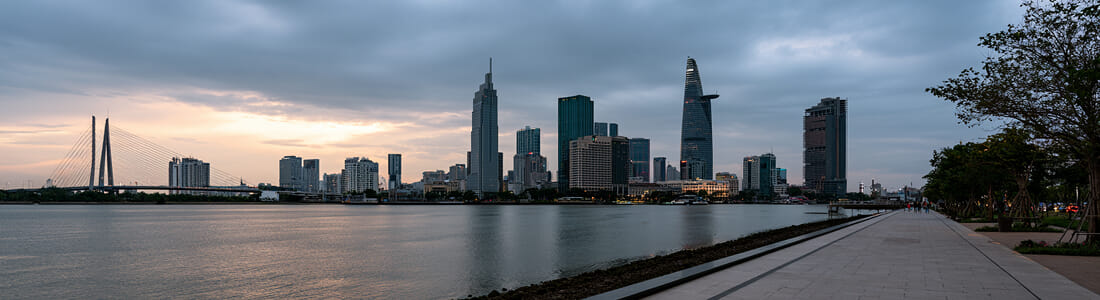


Local government throws its full weight behind firms from abroad. For a foreign investor, setting up here usually splits into two legal layers: the investment project and the birth of the enterprise. Each layer answers to its own body of rules. The first set of relations sits under the Law on Investment, while the forming, running, reshaping and winding-up of companies rests on the Law on Enterprises.
This piece looks at the quirks of launching here, because the metropolis keeps a distinct administrative practice of filing through local offices. The municipal bodies work to their own internal rulebooks, yet the entrepreneur’s step-by-step path is fully folded into the official state portal.
Opening a company in Ho Chi Minh City: the legal base
Registration here is built on investment and corporate rules together. I read them as a pair, since a slip in one block tells on the whole launch.
The core statutes for an HCMC company
The table sets out the laws in force that govern the corporate and fiscal sides of forming a business here.
|
Name of the act |
What it governs |
|
Law on Investment |
Fixes how investment activity is carried on within Vietnam and the rules for sending capital outward |
|
Law on Enterprises |
Governs the forming, running, reshaping and winding-up of legal entities — LLCs, joint-stock companies, partnerships and private structures alike |
|
Act amending the Law on Enterprises |
Alters and adds to the main document, standing as the current amendment to the corporate rules |
|
Decree on Enterprise Registration |
Lays down the renewed order of registration across the city and Vietnam at large after the 2025 reform |
|
Law on Corporate Income Tax |
Marks out the taxpayers, the taxable income, the fiscal base, the methods of calculation and the reliefs |
|
Law on Value Added Tax |
Governs the objects of VAT, the categories of payer, and the rules on deductions and refunds |
The bodies behind registration in HCMC
Carrying the law into practice is coordinated by a branching system of authorities, national and local alike.
Vietnam’s Ministry of Planning and Investment shapes the overall economic policy — it sets the strategic priorities for the national economy and coordinates the rules for admitting foreign capital. Putting those principles into effect falls to the specialised arm, the Foreign Investment Agency (FIA), the executive office that keeps a global watch on the commercial moves of non-residents. To keep the recording of new entities transparent, the National Business Registration Portal (NBRP) runs as a single electronic network; the digital platform gathers the charter data and opens a window onto the official database of every legal entity in the country.
At the regional level, though, the route takes on a marked character of its own, since the real powers are handed to local offices. The main coordinating node is the Department of Planning and Investment (DPI), whose staff run a full audit of the lodged documents against the local rulebooks. Forming the entity falls to the Business Registration Office (BRO), which issues the Enterprise Registration Certificate (ERC) — the title document confirming a new subject of civil commerce. The office sits within the DPI structure, enters the new company in the register and passes the data to the Tax Department, which assigns the subject its fiscal code. The whole many-step path is mapped in fine detail on the interactive eRegulations platform, which mirrors the exact order of moves for an applicant.
Why business picks Ho Chi Minh City
The city is showing an unmatched surge of business activity, locking in its standing as Vietnam’s prime economic engine. By the Department of Finance’s official figures, FDI in 2025 rose 24.2% on the year before, reaching USD 8.37 billion — the highest reading of any region in the country. Cumulative live foreign investment at the close of 2025 stood near USD 142.2 billion across more than 20,470 active projects. The momentum has kept its explosive cast into 2026: in the first two months alone the city pulled in another USD 900.2 million, moving firmly toward an annual target of USD 11 billion.
Five legal and strategic draws set this jurisdiction apart from others in the region:
- exclusive tax breaks. The city holds a singular self-standing legal status that lets it pilot special economic mechanisms found nowhere else in Vietnam. The headline draw for the technology sector is a full five-year CIT exemption for startups in innovation, science and high tech. On top of that, investors are wholly freed from personal income tax (PIT) on transferring or selling stakes in such companies, and the international experts they bring in get a five-year tax holiday on their pay;
- no hard floor on charter capital. Unlike most popular Asian jurisdictions, where a foreign investor must deposit large fixed sums at registration, Vietnamese corporate law sets no rigid lower bar for the mass sectors (IT, consulting, marketing, B2B services). The law asks only that the capital be "commensurate and sufficient" to launch the declared model, which slashes the financial barrier to entry;
- 100% foreign ownership with no compulsory local beneficiaries. Vietnam runs one of the most liberal regimes for investors in South-East Asia. Across the bulk of sectors, foreign nationals may hold the whole of a company. There is no need to bring in nominee local directors or to split the share capital with Vietnamese citizens; the non-resident keeps absolute operational and strategic control of the asset;
- a singular FTA web — a duty-free hub of global reach. Vietnam is the only developing economy in the region inside all the major free-trade pacts at once — EVFTA (with the EU), CPTPP (the Trans-Pacific community) and RCEP (the Asia-Pacific) — and it also holds Comprehensive Strategic Partner status with the United States. Set up here and the entrepreneur gains direct duty-free reach into the markets of the EU, the US, China and Japan;
- a "clean" jurisdiction with preferential free zones on offer. Vietnam is not, in law, an offshore, which lifts any risk in clearing tough international banking compliance (unlike the classic island zones) and keeps the company off tax-authority blacklists. Place the business in one of the city’s specialised zones — the Saigon Hi-Tech Park (SHTP), for instance — and the CIT rate legally falls to 10%, with up to four years of full exemption and a 50% discount across the nine years that follow.
Setting up in HCMC: a foreign investor’s market access
Letting overseas capital into Vietnam’s economy rests on a strict grading of sectors by how much they matter to the state. I begin the legal audit of any project by matching the planned activity against the country’s WTO commitments and the Law on Investment. The founder has to verify the legal standing of the chosen line before lodging anything, since the law splits every sphere into three self-contained categories:
- fully open lines (barrier-free access). In these niches a non-resident may build a business with 100% ownership. Here sit software development, IT consulting, marketing research and wholesale export-import trade (excise goods aside). For such projects the standard registration cycle is enough;
- conditional sectors (limited access). This group calls for specific regulatory terms to be met, touching ownership structure or special permits. A clear case is logistics and freight forwarding, where the foreign stake is capped at 51%. Retail wants a separate trading licence from the Department of Industry and Trade. International education centres face minimum financial thresholds reckoned per enrolled student;
- barred spheres. The law shuts foreigners out of certain segments entirely. In my experience investors sometimes forget the outright bar on the debt-collection trade. Absolutely off the table too are the buying and selling of rare flora or fauna and the trade in toxic chemicals.
A non-resident opening a company in Ho Chi Minh City
Vietnamese corporate law puts several organisational models on the table:
- LLC — a limited-liability company. This format is named outright in the list of regulated forms. It is the base choice for a foreign backer planning a firm with one or several participants. Whether full foreign ownership is on is checked against the chosen activity code; the general minimum charter capital for a standard build is set by the nature of the project;
- JSC — a joint-stock company. Fits commercial ventures with several co-investors, public capital to be raised later or shares to be issued. The caps on the foreign stake are set by the specifics of the particular sector;
- partnership. The Law on Enterprises also lists partnerships among the options. For overseas business this model is the least all-purpose, owing to the joint and several liability of the participants, so it rarely figures as the main vehicle for a commercial start;
- private enterprise. The law allows this model for non-residents too. Yet foreign entrepreneurs usually do not treat it as a priority, since it brings no full-blown legal entity into being.
How to register a company in HCMC
Registration takes in an investment analysis, the corporate filing, the tax launch, a bank account and the sector permits. The order shifts with the project, but the base algorithm runs like this:
- Checking the line of work. I settle whether the planned activity falls among the open, conditional or barred lines for a foreign investor. The check runs against the Law on Investment, which governs the terms for conditional sectors and the access of foreigners.
- Choosing the organisational structure. The founder fixes the future entity’s legal standing under the Law on Enterprises. The pick is usually between a joint-stock company and an LLC.
- Preparing the investment file. The data on the investor, the planned activity, the place of realisation, the term, the capital, the source of funds and the declared work are pulled together. The law defines an investment project as a set of proposals to commit capital in a particular geographic zone over a set period.
- Securing the investment registration certificate. Where the chosen model wants an investment certificate, the materials go to the DPI office for the place of realisation. The pack takes in the investor’s legalised corporate papers, financial guarantees and a formal office-lease agreement. The upshot is an investment registration certificate, on paper or electronically.
- Securing the enterprise registration certificate. After the investment stage the corporate file goes to the BRO. Where the documents meet the law’s mandatory asks, the competent body decides in favour and generates the ERC. The company is automatically given a unique 10-digit code, at once its registration number and its single Tax ID.
Once registered, the company has to switch on its commercial profile at the Tax Department for the CIT that follows. The director then opens accounts at an authorised institution and sees that the declared funds are credited on the approved schedule and to local banking practice. Where the chosen sphere is conditional, the company applies for the special licences at the relevant bodies before any operations begin.
Taxation of a business in Ho Chi Minh City
Vietnam’s fiscal system takes a graded line on taxing profit by the scale of the activity. The table draws together the current direct and indirect rates in play.
|
Tax measure |
Rate / condition |
|
Standard CIT rate |
20% |
|
Reduced CIT for small business |
15% for firms with annual revenue no higher than VND 3 billion (about USD 106,000) |
|
Intermediate CIT rate |
17% for firms with annual revenue above VND 3 billion up to VND 50 billion (USD 106,000 to 1,750,000) |
|
Base VAT rate |
10%; a 5% rate or an exemption applies to a range of operations |
Practical risks when opening a company in HCMC
The first risk is misreading the line of work. The Law on Investment ties a foreign investor’s access to market terms, bars and special asks for particular lines. Misjudge the sector caps for non-residents and the result can be a flat refusal of the investment certificate.
The second is declaring the charter capital wrongly. Pulling the financial figures in the file out of thin air drags the state approval out badly.
The third is slips in the corporate documents. Where the materials are incomplete or the data clashes with the asks, the body sends a written notice to fix them. Mismatches in the charter papers can stall or even block the registration certificate.
The fourth is a tax model with no calculation behind it. A new CIT law has run since the 2025 tax year, and a new edition of the VAT law since that July. Ignore the updated rules and penalties bite from the first days of keeping the books.
Who an HCMC company suits
Setting up here suits trading, service, technology and production projects. The single condition: the chosen activity has to be open to a foreign investor or meet the set licensing asks.
The jurisdiction fits a business that wants a clear administrative route. Vietnam eRegulations lays out step-by-step guides to the investment procedures in seven provinces and cities, the metropolis among them.
It does not fit projects that want to start work without first checking the sector. In Vietnam the clearance to operate hangs on investment admission, the sector terms and the substance of the project.
In closing: opening a company in Ho Chi Minh City
I shepherd a setup here as one linked process. First the foreign investor’s access to the sector is checked. Then the investment file is readied, the type of enterprise is chosen, the registration is arranged, the account is opened and the tax model is built.
The gain from that shepherding is a lower risk of refusal, delay or a wrongly chosen structure. For this city it matters especially. The metropolis is handy for entering the Vietnamese market, but it asks for a precise fit between the project, the capital, the address, the line of work and the documents.

 Audit and Accounting support
 Open an account in Vietnam
  Establishing an NGO in Vietnam
  How to get a Golden Visa in Vietnam
  Obtaining a DN Business Visa in Vietnam
  Costs of Buying Property in Vietnam: Fees, Taxes, and Hidden Expenses
  How to Obtain a Residence Permit in Vietnam for Heads of Representative Offices and NGOs
  Getting a Vietnam investment visa (DT category)