























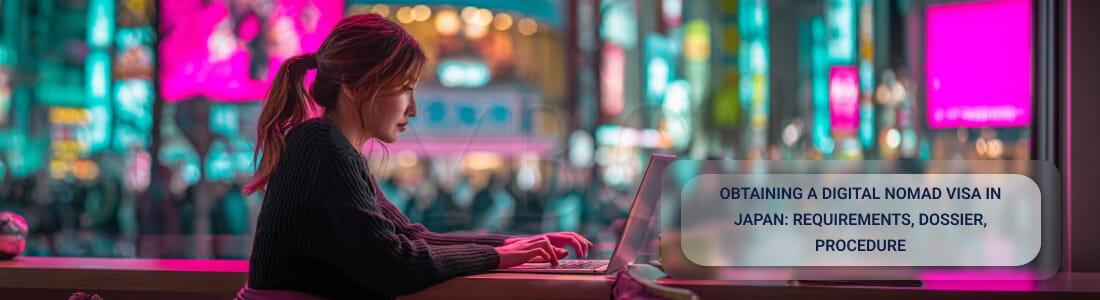



With a Japan digital nomad visa, specialists in digital fields may lawfully stay up to six months in an economy ranked among the most technologically advanced worldwide, while still doing remote work for companies abroad. The regime entered Japanese immigration law as a special category of stay called Designated Activities, meant for foreigners who draw a steady income from sources abroad.
At the same time, a Japan nomad visa opens no long-term immigration path. It permits a temporary stay of no more than half a year, which cannot be extended from inside the country. The financial thresholds, moreover, are fairly high.
Geography also limits access to the Japanese digital nomad permit. Applications are open only to citizens of the states included in a special list. Nationals of those states need no visa for brief trips to Japan, and every listed state has concluded an agreement with Japan on avoiding double taxation.
Below, I examine the legal design of the programme: the requirements for the applicant, the supporting materials and the sequence of steps for an application through a consulate.
Digital nomad visa Japan: legal framework
Legally, the visa belongs to Designated Activities, a residence category reserved for specific situations involving foreign nationals in Japan.
In practice, the applicant thus obtains entry permission tied to one particular residence status under immigration law. That status exists for a temporary stay combined with remote work connected exclusively with business abroad. This category admits no employment relationship with a local employer.
The length of stay deserves particular attention. Each digital nomad visa in Japan authorises a stay lasting at most six months, counted from entry. Extensions cannot be obtained inside Japan, and the foreigner must depart once the authorised stay expires.
Once a holder has completed the full six months, a further application is possible only after at least half a year spent outside Japan. Immigration authorities thereby prevent a temporary permit from turning into a long-term pattern of residence.
Government bodies administering the programme
Responsibility for administering the Japan remote work visa programme is divided between two government bodies.
The Immigration Services Agency (ISA) applies immigration legislation and defines the conditions on which remote professionals may make use of the Designated Activities status. It fixes the admission criteria, publishes explanatory guidance on the programme and monitors whether foreigners in Japan observe the rules of stay. In addition, the agency issues the Certificate of Eligibility, which attests that the intended activity complies with immigration legislation.
The diplomatic service handles the visa procedure outside Japan. Embassies and consulates accept applications, examine the documents and rule on whether to grant entry permission.
Japan digital nomad visa requirements: who qualifies
The scheme targets a limited group of foreign nationals. Immigration rules lay down admission criteria concerning the country of citizenship and the source of income, together with the level of earnings and medical cover. Relatives of the main applicant are subject to rules of their own.
Citizenship and the ISA country list
Eligibility is confined to nationals of states on a dedicated ISA list. The list comprises jurisdictions that meet two conditions at once:
- their nationals may visit Japan briefly without a visa;
- a double taxation avoidance agreement with Japan is in force.
With both conditions met, Japan can screen applicants more simply and keep tax risks low while foreigners live there temporarily.
Permitted employment
Only professionals whose earnings come from outside the local economy are eligible for a Japan nomad visa. Contractual remote work for an overseas firm is permitted, as is the supply of services to customers based abroad.
- an employment contract with an overseas employer;
- a freelance agreement with a company abroad;
- entrepreneurial activity serving customers outside Japan.
Nomad visa Japan: earnings threshold and health insurance
Immigration rules set a high financial threshold for applicants seeking the remote worker permit. The foreign professional has to document yearly earnings of no less than JPY 10 million (roughly USD 63,000).
This threshold exists so that a participant can meet living costs while in Japan without seeking work locally.
Another mandatory condition concerns medical expenses. For the entire period in Japan, a private policy must pay for treatment of illness or injury, and the sum insured cannot be lower than JPY 10 million (about USD 63,000). Such insurance reduces the financial burden that foreigners seeking treatment place on the Japanese healthcare system.
Family members
Japanese law allows close relatives, namely a spouse and minor children, to enter together with the principal applicant. Each relative must supply proof of kinship and medical insurance. In this case the financial assessment considers the maintenance of each family member, so the applicant has to demonstrate income sufficient for all accompanying persons.
Contact our specialists
Document package for the application
A Japanese digital nomad visa application rests on these core materials:
- the visa application, completed and accompanied by a photograph, giving particulars of identity, the income stream, the home address abroad and the planned length of the visit;
- a passport that remains valid until the planned stay ends;
- the Certificate of Eligibility, which shows that the declared activity conforms to immigration law; holding it usually shortens the visa review;
- a statement of the planned activity and its timeframe, which names the income stream, the overseas employers or customers, the anticipated length of the visit and the intended Japanese address;
- evidence of yearly earnings in the form of tax returns, income certificates, labour contracts or agreements with overseas customers;
- health insurance evidenced by an international policy or by confirmation of cover through a corporate programme;
- where required, papers for accompanying relatives, namely proof of kinship, a photocopy of the main applicant's passport and health cover for each dependant.
Consular offices may impose additional requirements on the paperwork. Both the exact list and the technical formalities sometimes differ from one diplomatic mission to another. Without a Certificate of Eligibility, processing usually takes longer, since the immigration authorities carry out an additional assessment of the stated grounds for entry.
How to apply for a Japan nomad visa: stages of the procedure
Obtaining the permit involves a sequential visa procedure conducted outside Japan. The procedure includes the following stages.
Screening the home jurisdiction and tax status
At the outset, the applicant must establish whether the ISA list of eligible jurisdictions includes the state of nationality concerned. Where the state is absent from that list, participation is not possible.
Evidence that income originates abroad
An assessment of the employment model follows. Both remote employment by a firm abroad and contract work for non-Japanese customers qualify. Earnings have to originate outside the Japanese economy, with documentary proof of that origin. Their amount must also be checked against the required minimum. At this stage the applicant collects evidence of incoming funds and the contractual documents.
Medical insurance
Ahead of any Japan remote work visa application, the applicant must purchase an international insurance policy that pays for treatment of illness or injury, with cover no lower than the prescribed minimum. Its validity must span every day of the planned residence, and it must pay for treatment received in Japan.
A written account of the activity and the stay
Anyone seeking the Japanese digital nomad permit prepares a written statement on the planned visit. The statement sets out what the remote work consists of, the overseas employer or customers behind it, the planned length of the visit and the intended Japanese address. This document helps the consulate understand the economic model behind the stay of a foreign professional.
Whether an eligibility certificate is needed
Next comes an application for the Certificate of Eligibility, which ISA issues to confirm that the planned activity is consistent with immigration rules. The certificate is optional for the visa. Holding one, however, usually speeds up the subsequent processing of the permit.
Filing with a diplomatic mission or consulate
When the documents are ready, the applicant lodges them with the consular post or embassy covering the district of residence. No application can be filed from within Japan, since the visa procedure runs exclusively outside Japanese territory.
Review of the application
After accepting the documents, the consular office verifies the information provided. Where the file raises no questions, the consulate normally needs about five working days, running from the day after acceptance. The review may take considerably longer, sometimes up to three months, if extra checks are carried out, the file lacks a Certificate of Eligibility or coordination with the immigration authorities becomes necessary.
Issue of the visa
Once the consulate approves the application, the applicant receives an entry permit in the Designated Activities category. At the border an immigration officer inspects the documents. The final decision on admission rests with border control, which also records a permitted stay of up to six months after entry.
Why Japan appeals to digital nomads
A Japan digital nomad visa appeals to applicants because it permits a fairly long stay in a country whose infrastructure makes remote work technically convenient. Unlike many other jurisdictions, Japan stands out for the high quality of its transport, digital and service environment.
Domestic mobility
Thanks to its transport network, Japan lets a visa holder travel freely between the main economic hubs while keeping one home base. The Shinkansen bullet trains are the clearest illustration.
On the Tokyo to Shin-Osaka run, a Nozomi train needs about 2 hours 21 minutes, and its maximum speed on this route is 285 km/h. As a result, a professional can live in one city and travel regularly to other business centres without flying. In effect, a visa holder can maintain one base for residence and use neighbouring metropolises for meetings, events and short trips.
Digital and everyday infrastructure
Japan is known for widespread internet access and a well-developed urban communications infrastructure. The official tourism portal run by the Japan National Tourism Organization notes the wide availability of public Wi-Fi hotspots across large cities, at transport hubs and in communal spaces.
Pocket Wi-Fi, a compact wireless router available for rent or for purchase and long-term use, complements this infrastructure. The small device provides a mobile internet connection while travelling around the country. With pocket Wi-Fi, a professional can work from trains, cafés, hotels or coworking spaces without being tied to a fixed network.
Work beyond the metropolises
Holding the visa does not confine residence to large cities. The country's tourism administration actively promotes the concept of the workation, a combination of work and leisure.
Under this initiative, new dedicated spaces for remote work are emerging. Among them are unconventional formats rarely offered in other countries:
- workspaces in historic temples;
- equipped sites in national parks;
- remote-work zones at campsites and nature resorts.
Such infrastructure lets a professional combine work with a stay in regions far from the metropolises. A remote specialist thus gains the option to change location without losing internet access or basic services.
Conclusion
With professional assistance, an applicant's actual circumstances can be checked in advance against what local law demands for a Japan digital nomad visa. Specialists assess whether the programme applies, verify the documents against the financial criteria and describe the remote activity in terms meant to leave the immigration authorities no doubt about the lawfulness of the intended stay. Such support carries particular weight where an applicant has several income streams, works under contracts or runs a business.