






















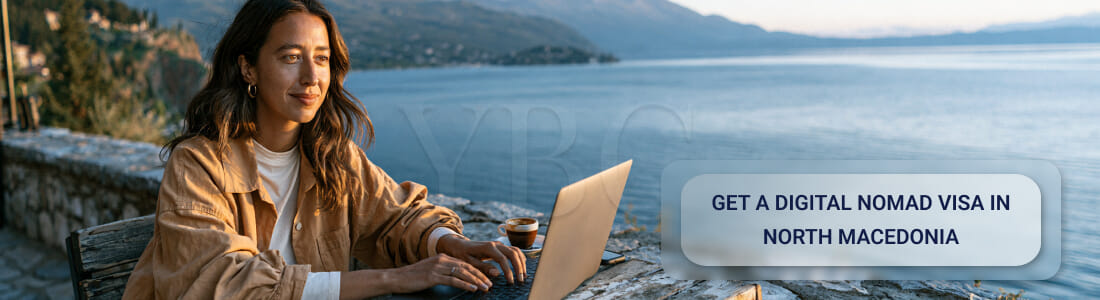



Ask a software engineer on an Amsterdam salary, a designer billing three agencies, or the owner of a small online shop what they want from the Balkans, and the answer converges: a lawful base that costs less and leaves the earnings untouched. That convergence is why getting a digital nomad visa in North Macedonia comes up so often. The awkward part is that no such document has been created. What exists are ordinary immigration grounds, temporary residence for work or entrepreneurial activity among them, and they carry a long stay perfectly well once matched to the right circumstances.
I set out below how to arrange a visa for a digital nomad in North Macedonia using those mechanisms, and where each of them stops being useful.
How to Get a Digital Nomad Visa in North Macedonia
Demand rose faster than the law. Officials floated a nomad programme in 2021, the announcement circulated through international media, and legislators never took it further. Anyone searching today for a digital nomad visa in North Macedonia is searching for something that was announced and abandoned.
- visa-free travel, where the applicant nationality carries that right;
- category D as a national long-term visa, filed ahead of any stay outrunning the short-term ceiling;
- temporary residence, once a statutory ground genuinely matches what the applicant does.
Guidance on how a freelancer moves to North Macedonia circulates widely and much of it describes a programme that was never enacted. Working from the statute instead of from those articles is what prevents refusals, breaches of the stay regime and the rest.
Which Options for Lawful Stay Are Open
Four patterns cover almost everyone I advise. A salaried employee keeps a foreign employer and forms no local relationship. A consultant bills overseas clients directly. A founder runs a company registered elsewhere. A fourth group trades through a structure established here. Where the money arises, how long the stay lasts and whether a business needs registering decide which of the three instruments fits.
Visa-Free Stay
Reconnaissance is what this covers: a first look, a flat hunt, a few weeks of work while deciding. Visa-free entry to North Macedonia for remote workers runs to 90 days and confers presence, not status. It replaces no permit, and stretching it is the single commonest way people put a later application at risk. Committing to a longer stay means settling the ground first and moving to obtain residence in North Macedonia.
The Long-Term Visa of Category D
Past that ceiling, category D takes over. Short-term visas serve tourism and business trips; this one serves whoever intends to arrange temporary residence in North Macedonia or already holds the decision and needs lawful entry to act on it. Nothing open-ended attaches to it. Entry is its whole purpose, which makes it a step on the route rather than the thing being sought.
Temporary Residence
Living here for any extended stretch means holding a temporary residence permit. Statute opens several doors to one:
- employment with an entity established locally;
- entrepreneurship run through a registered structure;
- self-employment invoiced in the specialist own name;
- study at a recognised institution;
- family reunification with a relative who already holds status.
Picking wrongly costs more than picking slowly. Whoever assumed they could simply arrange a Digital Nomad visa in North Macedonia discovers that an unsuitable category produces either a refusal or a second run through the whole procedure.
Residence Requirements in North Macedonia
Purpose, means and administrative conformity are the three things a foreign citizen evidences. Beyond that the documents for obtaining residence for digital nomads in North Macedonia shift with the ground, though a common core recurs:
- a foreign passport whose validity comfortably outruns the period applied for;
- materials that evidence the declared purpose rather than assert it;
- confirmation of where the applicant will actually live;
- proof that financial means exist and arrive with some regularity;
- medical insurance valid for the territory and the intended period;
- further papers that vary with the ground on which the permit is sought.
Earning well online confers nothing on its own. The category has to be right and conformity with it demonstrated. How that demonstration works differs by profile: a freelancer explains the character of the activity, a founder produces the corporate file, an employee evidences a relationship that sits abroad.
Arranging Residence for a Digital Nomad in North Macedonia
Arriving visa-free and expecting status to follow is the misunderstanding I correct most often. Ground first, documents second, competent authorities third.
Determining a Suitable Ground. Everything starts from the applicant own situation. Official sources list work, study, family reunification, scientific activity and professional training among the purposes for which temporary residence is granted. For remote specialists this is the hard part, because "digital nomad" is not an independent category and the fit has to be constructed.
Preparing the Documents. With the category fixed, the pack follows. Where remote work underpins the application, material showing the professional activity is stable does the heavy lifting:
- contracts with the clients actually served;
- confirmation of entrepreneurial status where such status has been taken up;
- company registration documents, if a structure stands behind the work;
- evidence that income arrives regularly rather than in isolated payments;
- anything further that demonstrates the applicant supports themselves.
Files assembled this way attract fewer queries and move faster.
Filing and Obtaining the Residence Permit. The application reaches the competent institutions with the pack attached. Registration carries a non-returnable administrative charge whatever the outcome. Officials run a preliminary check, assess conformity, enter the applicant in the migration system, and the competent bodies then grant or refuse residence in North Macedonia for a digital nomad.
Timing follows the ground chosen, the completeness of the file and the load on the authorities. Presence granted for a limited period does not stretch itself while a decision is pending, which is why anyone entering on a short-term basis plans the sequence in advance. Migration registration applies to everyone after arrival regardless of length of stay, and the Ministry of Internal Affairs offers an electronic route.
Taxes for Digital Nomads
Holding residence in North Macedonia for remote specialists answers a migration question, not a fiscal one. A permit creates no automatic obligation to pay as a resident. Days spent here, where income arises and the place a business is run from all bear on tax status independently.
Before a move, and before arranging residence in North Macedonia for a freelancer, the situation repays analysis, particularly where the specialist:
- draws income from clients located outside the country;
- holds ownership in a company registered in another jurisdiction;
- works under contract with an employer established abroad;
- expects to spend the greater part of the year physically present here.
Personal taxation is refreshingly simple: 10% as the standard rate across various categories of income. Whether it bites at all depends on three questions:
- whether the person meets the test for resident status;
- where the income counts as having been received;
- whether a double-taxation agreement links this country with the state of origin.
Trading through a locally registered company brings corporate taxation at 10%, reaching resident companies and the permanent establishments of foreign ones in the cases statute provides. VAT matters to entrepreneurs and to anyone supplying services, and two rates operate:
- the standard rate, 18%;
- the reduced rate of 5%, covering the categories of goods and services legislation specifies.
Per the Ministry of Finance, registration becomes compulsory once total taxable turnover passes 2,000,000 Macedonian denars in a calendar year. Specialists billing only foreign clients need VAT assessed separately, against the character of the services, the place of supply and the rules that apply.
Advantages for Digital Nomads and Remote Specialists
No dedicated programme exists, yet the appeal survives it. Relocation to North Macedonia trims outlay while leaving international work untouched, which is why searches like residence in North Macedonia for freelancers keep multiplying. Skopje absorbs most arrivals thanks to infrastructure, international services and professional density; Ohrid, Bitola and smaller towns attract whoever prefers quiet and lower bills.
- a one-room flat in Skopje, around 250 to 400 euros a month depending on district, condition and location;
- utilities for a standard flat, in the range of 80 to 150 euros a month;
- mobile and internet packages, 10 to 25 euros a month;
- food, which tracks lifestyle, though local products and services stay noticeably cheaper than across much of Western Europe.
Set against a minimum wage of roughly 420 euros, the gap between domestic earnings and what a specialist paid by an international company can spend becomes obvious. Connectivity supports the model: broadband and mobile services reach the larger cities, a full working space can be organised at home or in coworking, and 4G coverage extends across practically the whole territory.
Contact our specialists
Mistakes Made When Trying to Get a Digital Nomad Visa in North Macedonia
Most people begin with the search query rather than with their own facts, assuming a programme sits behind it. Statute provides no permit reserved for those working online for overseas employers, so the instruments already in place carry the load: category D and temporary residence, with the matching category settled case by case.
Mistake 1. Hunting a Visa That Does Not Exist
Outdated articles, international round-ups and unverified sources send applicants looking for the wrong thing. Reverse the order: establish the circumstances, then find the ground. One specialist can have several routes depending on the details:
- an employee of a foreign company weighs status against the character of the employment;
- an entrepreneur considers options tied to business activity;
- the owner of an international business factors in corporate structure and tax;
- anyone moving with family accounts for the grounds covering relatives.
Which ground statute offers for lawful residence, given the particulars of the professional activity, is the question worth answering.
Mistake 2. Choosing the Wrong Ground
Applications are read against a specific legal basis, and whoever receives residence for a stated purpose keeps to that category conditions. Filing without a clear understanding of the basis produces refusal or repetition. Before documents are prepared I help clients assess:
- what status the applicant actually holds, as against the assumed one;
- where the source of income genuinely sits;
- whether the professional activity needs registering at all.
Mistake 3. Stretching a Tourist or Short-Term Stay
Living at length on visa-free entry substitutes for no long-residence permit, and anyone planning past three months studies the corresponding status beforehand. Registration at the place of residence is obligatory too: hotels handle it at reception, private housing within the established period. Ignoring it complicates everything that follows.
Mistake 4. Thin Evidence of Activity and Means
Applicants confirm the circumstances their case rests on. A recurring problem in my practice is the specialist who genuinely works remotely yet cannot document:
- the source from which income is received;
- the character of the professional activity carried on;
- financial resources stable enough to support a stay;
- the lawfulness of the employment under the rules governing it.
- Preparation therefore runs wide, with supporting material for the chosen ground obtained in hand.
Mistake 5. Ignoring the Tax Consequences
Treating the permit as a purely migration matter is the last of them. Significant time here, foreign income or a business run from this country all raise fiscal questions that want answering separately.
What the Absence of a Digital Nomad Visa in North Macedonia Changes in Practice
A dedicated programme does two things at once: it names remote work as a lawful purpose and fixes a term against it. Borrowing a general ground separates those. The purpose comes from a category written for something else, and the term follows that category rather than the working arrangement.
So the ground has to keep matching reality for as long as the permit runs. Where residence rests on entrepreneurship and the business stops trading, or on employment and the contract ends, the basis has thinned while the card is still valid. Renewal is where that shows.
Changing client or employer mid-permit catches people out. A specialist who moves between foreign contracts has changed nothing about life here, yet may have changed the facts the permit was issued against, and whether that needs reporting is worth knowing before rather than after.
Family members inherit the stability of the ground beneath them. Reconsider the principal basis at renewal and dependants are reconsidered with it, which planning that treats their permits as separate tends to miss.
Comparing the Realistic Grounds to Obtain Residence in North Macedonia
Employment with a local company looks cleanest on paper and is least available in practice, since a specialist serving foreign clients has no local employer to produce. Where a real local role exists the route is simple; where one is constructed for migration purposes it invites the scrutiny it was meant to avoid.
Entrepreneurship suits whoever will register locally and invoice through that structure. It converts a freelance arrangement into something the system recognises, at the cost of accounting duties and a corporate tax position running alongside the personal one.
Self-employment sits between them and often answers the specialist billing foreign clients directly. Its attraction is proportionality; its difficulty is evidential, since a pattern of work has to be proved rather than a single relationship.
What decides is rarely paperwork. It is which arrangement can be sustained across the whole permit and described consistently in the migration filing, the tax position and the banking relationship.
Renewal of a Residence Permit in North Macedonia
A first permit is judged on intention; a renewal is judged on what happened. Applicants who built a convincing file at the outset and let the arrangement drift afterwards meet that difference at the counter, with their original declaration in front of the reviewer.
Income that paused, resumed or moved between counterparties is no problem provided it can be narrated. Unexplained gaps, or a change in the shape of the work that contradicts the ground, are what create difficulty.
Assembling the renewal file as the year runs, rather than in the month before expiry, is the practical answer. Contracts, payment records and evidence of presence are trivial to keep as they arise and awkward to reconstruct later.
Conclusion: How a Remote Specialist Obtains a Visa Here
The query get a digital nomad visa in North Macedonia stays popular among specialists heading for the Balkans, and no such visa exists to meet it. Working instruments carry the same result, and the decisive stage is a competent choice of ground with the professional activity and the tax consequences both weighed.
Before a move I recommend a legal assessment and an individual strategy for arranging status. I can assess the migration and tax consequences and provide full support through the process of arranging residence in North Macedonia for digital nomads.