
























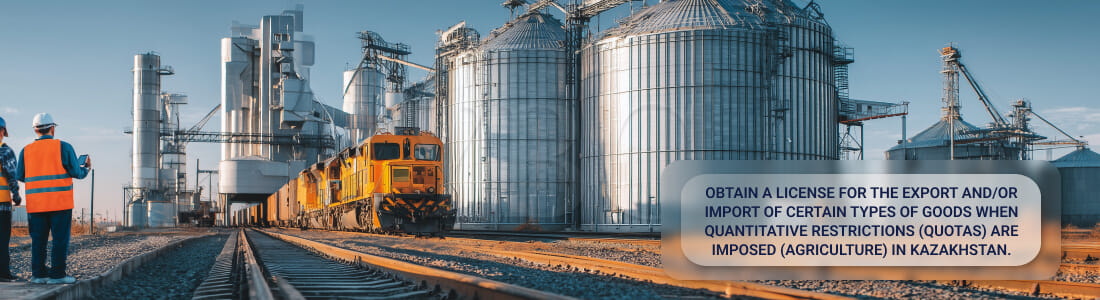



This material lays out the current regulatory architecture and a step-by-step algorithm for working on the electronic licensing portal. I have analyzed licensing of agro-industrial goods under quotas in Kazakhstan, taking into account the latest changes to the rules for automatically allocating export rights, covering the documents, timeframes, and financial costs involved.
Regulatory and Legal Basis for Licensing Under Quotas in Kazakhstan
The non-tariff regulation system rests on a multi-level foundation that sets the rules of the game for participants in foreign economic activity. The base supranational regime is fixed in Annex No. 7 to the Treaty on the EAEU, which sets general rules for applying restrictive instruments in trade with third countries. To arrange an export license under the current quotas in Kazakhstan, a company must demonstrate compliance with both EAEU law and national regulation.
The procedural order for issuing permit documents in 2026 is governed by Decision No. 125 of the EEC Council, which sets the uniform forms through which licensing of AIC product exports within the EAEU is carried out. Kazakhstan has fixed these conditions in its own regulations, making the accounting of every shipped batch verifiable.
- the Law "On Regulation of Trading Activity" (Articles 17 and 18);
- the legislative act "On Permits and Notifications";
- subordinate orders issued by the profile agency, the Ministry of Agriculture of the Republic of Kazakhstan, covering specific areas of agricultural policy;
- the Tax Code, in the part establishing and administering mandatory state payments.
The system for distributing export quotas on Kazakhstan's territory operates under Ministry of Agriculture regulations, which set restrictions on specific HS codes for a limited period. The license here functions as the legal instrument confirming a party's entitlement to a share of the overall state limit, the sole lawful basis for completing a transaction.
The current arrangement of an export license for agricultural goods under quotas in Kazakhstan requires studying the current industry orders in advance, since legislation treats licensing as a method of protecting the economy from raw-material shortages. Under this order, an import license under quantitative limits in Kazakhstan, or clearance to export, is granted only after the contract is checked against the established requirements.
Authorized Body and Electronic Platform: Where to File an Application for Export-Import Permits Under Quotas in Kazakhstan
The Ministry of Agriculture of the Republic of Kazakhstan is the competent state body that sets the regulatory requirements for the agro-industrial complex and issues the necessary permit acts, determining the volume of restrictions and monitoring the targeted use of allocated limits. To arrange an export license for AIC products from Kazakhstan, an entrepreneur deals with the state apparatus exclusively through digital channels.
The main operational platform is the state portal eLicense.kz, which brings together all permit-related services. Its structure includes a dedicated section for foreign-trade participants, where an export license in Kazakhstan is selected, and the interface allows a request's status to be tracked in real time. The procedure requires authorization through an electronic digital signature, after which it becomes possible to file an application for an export license in Kazakhstan. This digital logic removes the human factor from checking an applicant's baseline parameters, speeding up licensing of agricultural product exports from Kazakhstan and shortening bureaucratic cycles.
The system automatically synchronizes with industry databases to verify an exporter's production capacity: through the e-Agriculture information system, the presence of grain storage facilities or feedlot sites is checked, confirming the status of a genuine producer. This kind of licensing of exports within the EAEU in Kazakhstan guarantees market access only to good-faith participants.
Data on every document issued flows immediately into the register of export quotas in Kazakhstan, keeping the remaining balance of the overall limit transparent. Electronic interaction between the Ministry of Agriculture and customs services simplifies border control, and established quotas on the export of agricultural products in Kazakhstan are administered through a single window that rules out double-counting of volumes.
Current Objects of Quota Regulation When Arranging a License for Agricultural Goods Exports in Kazakhstan
State regulation of the agricultural sector aims to preserve a balance between supporting producers and protecting the domestic consumer. By setting physical caps on export volume, the government minimizes the risk of shortages and sharp price swings on socially significant products.
The current export quota on meat in Kazakhstan covers key positions in beef and lamb, requiring a business to obtain a permit document for every planned transaction. For live animals, strict quantitative limits tied to age categories apply, and arranging a permit for the export of agricultural products under quotas in Kazakhstan is allowed only within state limits approved by Ministry of Agriculture orders.
For the current period, a temporary restriction applies to certain livestock categories in the form of a full export ban through the end of April; once that period ends, the quantitative-regulation regime, meaning quotas, set out in the current rules applies.
- chilled and frozen beef (HS codes 0201, 0202): a limit of 20,000 tonnes through 30.06.2026; for the current period, a full export ban applies through the end of April;
- bull calves over 12 months old (HS code 0102): a volume of 60,000 to 85,000 head; for the current period, a full export ban applies through the end of April;
- lambs over 4 months old (HS code 0104): a total volume of 120,000 head; for the current period, a full export ban applies through the end of April.
Profile agencies closely monitor the situation on neighboring markets. When demand from external buyers creates a threat to domestic security, licensing of agricultural exports from Kazakhstan is introduced for raw-material groups, allowing product flows to be regulated promptly without a full trade ban.
For crop production, a flexible-response mechanism applies: current grain quotas in Kazakhstan for wheat, rapeseed, and sunflower depend on data from monthly stock monitoring. If the domestic balance reaches critical marks, export operations shift to a temporary licensing regime through separate government resolutions.
Any commercial export of agricultural products from Kazakhstan under quota-controlled HS codes requires advance confirmation from the regulator. An error in determining the code, or an attempt to export beyond the limit, leads to the customs declaration being blocked. Transparent quotas on agricultural goods in Kazakhstan make the market predictable, yet force companies to compete for access to limited resources. Every license for meat exports from Kazakhstan obtained confirms the enterprise's right to ship goods within the approved country limit.
Procedure for Allocating Quotas in 2026 for Licensing Exports from Kazakhstan
The updated resource-allocation model, in force since 31 December 2025, entirely rules out manual management of the process. The main allocation of export quotas in Kazakhstan takes place in automated mode through information systems. The main tool for interaction between business and the state is the electronic licensing portal, where the right to export is secured for the applicant instantly.
The system works on a first-come, first-served basis: whoever registers a request first gets access to the available volume. Obtaining a permit for the export of agricultural products under quotas in Kazakhstan demands the fastest possible action from management and responsible specialists on the day the limits open. For the meat-product group, differentiated threshold values have been set, determined with reference to the production and logistics capacity of the specific enterprise.
- a feedlot capacity of 5,000 to 10,000 head gives an available annual limit of up to 1,000 tonnes, verified through e-Agriculture data;
- a feedlot capacity of 10,001 to 50,000 head gives an available annual limit of up to 5,000 tonnes, verified through the ISZh database;
- a feedlot capacity above 50,000 head gives an available annual limit of up to 10,000 tonnes, verified through confirmation of capacity by the Ministry of Agriculture.
The existing quota limit on agricultural exports from Kazakhstan is set automatically based on data about the company's assets. The software system analyzes information in the e-Agriculture database, matching it against the exporter's request. These rules for allocating export quotas in Kazakhstan give priority to large producers who own their own raw-material base.
Particular attention goes to preparing the product's digital profile. Since January 2026, mandatory registration of goods in the National Commodity Catalogue before export in Kazakhstan has become a technical condition for activating a license. Without a unique code from the National Commodity Catalogue, the system will not let the application be completed, even if the overall limit has not yet been exhausted.
Understanding how export quotas are allocated in Kazakhstan lets companies build long-term contracts with foreign partners. The main burden falls on the preparation stage: by the time applications open, all data on livestock numbers and capacity must be up to date in the state databases. Access to the meat-product export quota in Kazakhstan is granted to organizations that meet the regulator's digital conditions and carry no outstanding debt to the budget.
Contact our specialists
How to Arrange the Permit and What Documents Are Required
Interaction with the authorized government bodies happens exclusively through electronic services, with every stage filed and processed online. The exporter's main working tool is the electronic digital signature, EDS, which verifies every action on the elicense.kz portal. To successfully obtain an export license for agricultural products from Kazakhstan, a company sets up a personal cabinet and completes a structured application form, where every field must match the supporting documentation exactly.
The basis for the regulator's decision is a legally sound contract with the foreign partner. The portal's algorithms require high-quality scanned copies of documents to be uploaded. The documents for an export license in Kazakhstan that meet this quality bar include:
- an electronic application in the established form;
- the foreign trade contract, with all specifications and addenda;
- documents confirming the agreed plans of the parties, where no formal contract has been concluded;
- confirmation of payment of the state duty, generated through the payment gateway.
The information system automatically checks data on the applicant's production resources: through integration with Ministry of Agriculture databases, the presence of the necessary storage facilities or livestock numbers is verified. This kind of filing of an application for an export license in Kazakhstan minimizes the risk of shell companies with no real connection to production taking part in trade, and verification runs in the background without officials involved.
While processing a request, the system compares the desired batch volume against the remaining balance of the overall state limit. If a company plans to obtain a license to import agricultural products into Kazakhstan, it also undergoes a check against phytosanitary and veterinary requirements, and the algorithm blocks a request where the organization is subject to restrictions on foreign economic activity.
Successfully clearing every stage results in an electronic license to export from Kazakhstan, available for download from the personal cabinet, carrying a unique QR code read by border and customs officers. This order of issuing export permits in Kazakhstan minimizes the risk of document forgery and lowers the likelihood of abuse.
Completing the administrative procedure for licensing the export of agricultural products from Kazakhstan is accompanied by an automatic notification sent to the State Revenue Committee, with data on the approved volume promptly reflected in customs authorities' information systems. Once fixed, the business is left to arrange the permit document for exporting agricultural goods under quotas in Kazakhstan and ensure the shipment happens within the set time window.
Timeframes and Cost of Obtaining Export and Import Permits Under Quotas in Kazakhstan
How quickly permit acts are issued has a direct bearing on the economic efficiency of foreign-trade deals. The period for issuing export clearance in Kazakhstan has been significantly cut through digitalization: where a free balance remains within the quota register and the electronic application is filled in correctly, the system completes its check within one working day.
To arrange an export permit, a business pays the established state fee of 10 monthly calculation indices, which under the law on the republican budget for 2026 equals 43,250 tenge. The amount applies uniformly across the country and is paid through the e-government payment gateway when the electronic application is formed.
A company should assess the full cost in advance, factoring in the payment itself and the cost of preparing industry opinions. From 1 March 2026, tighter currency control takes effect: the National Bank and the State Revenue Committee will begin exchanging information on issued permits daily, so any delay in fulfilling a contract becomes visible to the regulator within a day.
Several critical factors can lead to refusal of an export license in Kazakhstan. The system automatically rejects a request where the countrywide quota is exhausted or where the individual limit set for a specific enterprise is exceeded. Checking the taxpayer's status is also a mandatory step: even a minimal outstanding debt blocks the process.
Any delay in filing documents risks losing the quota because of stiff competition among exporters. Arranging an export permit in Kazakhstan requires the applicant's data to be up to date across every linked state information resource. Practical experience confirms that well-prepared market participants send their document package for arranging a permit to export agricultural products from Kazakhstan within the first hours after the official start of limit distribution. That approach raises the odds of promptly arranging export clearance under quotas in Kazakhstan and locking in the volume available for export to the company.
Conclusion
Effective work in Kazakhstan's agricultural market requires entrepreneurs to combine market knowledge with flawless command of digital tools. The shift to automated limit distribution has made the process transparent, but it has raised the bar for a company's internal data preparation, since success now depends on synchronizing warehouse balances, veterinary records, and tax standing across state systems.
To scale a business abroad, quota regulation has to be treated as a permanent element of planning. Timely engagement with foreign-trade support specialists helps offset technical risks and reliably obtain a license to export agricultural products from Kazakhstan. Amid global competition for food supply, the speed and accuracy of legal processing matter as much as the product's quality itself.

 Opening a bank account in Kazakhstan
  Having an eye on the condition of digital mining sector in Kazakhstan
  Registration of a Payment Operator in Astana IFC Kazakhstan
  Launching an Investment Venture at the Astana International Financial Center (AIFC) in Kazakhstan
  Registration of a Cryptocurrency Company in Astana IFC, Kazakhstan
  Company registration in Astana Hub
  Redomiciliation of a company to the AIFC, Kazakhstan