






















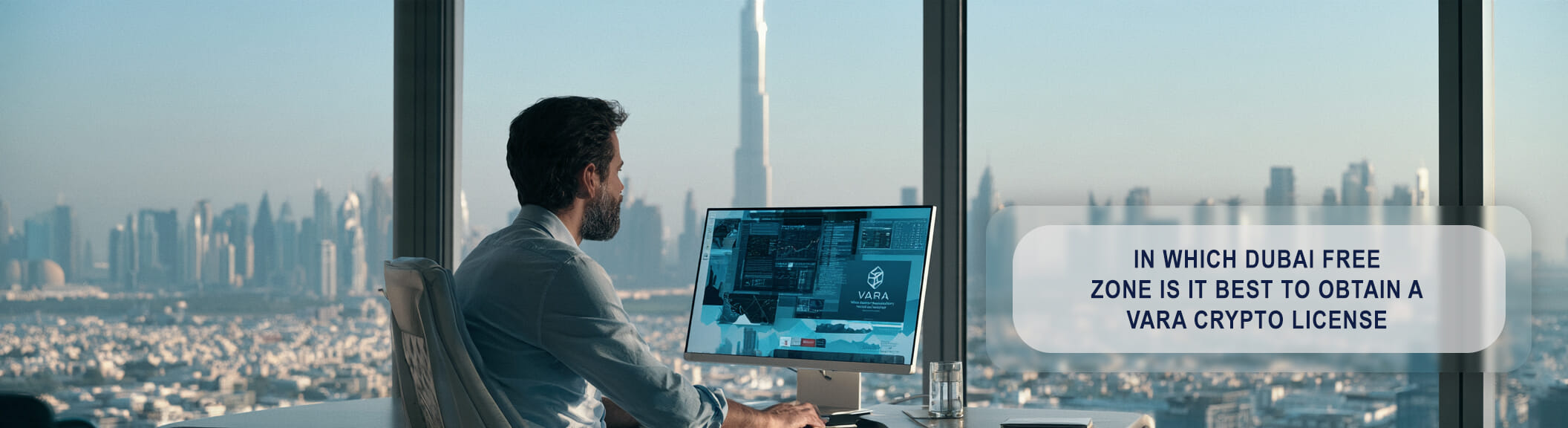


Picking the zone comes first for any crypto license in Dubai; planned operations largely settle that choice. Registering in a zone confers no right to offer regulated services with virtual assets; that permission is a separate matter for VARA.
DMCC fits many crypto ventures, though by no means every model. Three factors steer jurisdiction choice: the firm's activity, the regulator's demands and the target market.
What VARA oversees
The Virtual Assets Regulatory Authority (VARA) oversees nearly every corner of Dubai, onshore territory and free zones alike. One enclave lies outside its reach: the Dubai International Financial Centre (DIFC), whose financial sector is overseen separately by the Dubai Financial Services Authority (DFSA).
Regulations VARA adopted in February 2023 spell out what market participants may do, which requirements bind them and what safeguards protect clients and investors. When drafting the rules, VARA gave weight to financial resilience and to safe cross-border transactions.
Every VARA license applicant has to convince the regulator that it genuinely grasps the planned business and can run the project competently. Scrutiny extends to who owns the venture, who controls it and where its money originates. The regulator also examines client-facing processes, the countries clients come from and in-house rules. A candidate can be authorized once it convinces the regulator that it commands enough resources to keep operating normally, including through outages, crises and comparable events.
Geographic limits of VARA authorization
Firms relocate to Dubai to work lawfully while serving markets well beyond the local one. Banks, business partners and clients alike look for counterparties that a regulator has vetted and that operate by its rules. A Dubai VASP License (the permit held by virtual asset service providers) answers that expectation and gives crypto ventures working across borders from Dubai a sound footing. VARA is building working ties with fellow regulators. If fully fledged mechanisms for mutual recognition of licenses between countries appear later, the license will carry more weight.
One point deserves investors' full attention. VARA's permission covers regulated crypto work only within Dubai's borders. Such permission is no nationwide pass letting a firm start work in any emirate without additional approvals. Elsewhere in the country, the federal Capital Market Authority (CMA) handles licensing.
|
Regulator |
Territory |
Mandate |
|
VARA |
The whole emirate, DIFC aside |
Supervises crypto activity throughout that territory |
|
CMA |
Rest of the UAE, DIFC and ADGM aside |
Federal regime for activity beyond Dubai |
|
DFSA |
DIFC only, Dubai |
Own rulebook, applying to financial firms based in DIFC |
|
FSRA |
ADGM only, Abu Dhabi |
Oversees finance, crypto included, within ADGM |
A VARA-licensed firm headquartered in Dubai can serve clients from many countries. Even so, each target country's rules need checking, as do client restrictions and sanctions regimes. A Dubai crypto license permits only those services named in its authorization. Broker or dealer authorization, for instance, gives no entitlement to run an exchange. Equally, custody approval does not stretch to exchanging virtual assets (VAs).
Eight activity lines under VARA
Dubai's crypto regime recognizes eight activity lines, and which license a firm needs follows from what it plans to do. Capital floors vary with each activity; for several, engaging a VARA-approved custodian changes the figure:
|
Activity |
Share of annual fixed overheads |
Capital floor, AED |
|
Advisory |
n/a |
100,000 |
|
Brokerage (broker-dealer), custodian engaged |
15% |
400,000 |
|
Brokerage (broker-dealer), no custodian |
25% |
600,000 |
|
Custody |
25% |
600,000 |
|
Exchange, custodian engaged |
15% |
800,000 |
|
Exchange, no custodian |
25% |
1,500,000 |
|
Lending/borrowing |
25% |
500,000 |
|
Management and investment, custodian engaged |
15% |
280,000 |
|
Management and investment, no custodian |
25% |
500,000 |
|
Transfer and settlement |
25% |
500,000 |
|
FRVA, fiat-referenced VAs (Category 1) |
n/a |
1,500,000 + 2% of available FRVA supply (by value) |
Where a row shows two figures, the higher one applies; for FRVA issuance the two amounts are added together.
Advisory work
Some firms in this market never handle client assets. A consultant may help a founder shape a token project's structure, weigh its risks and plan the launch. Such an adviser neither holds cryptocurrency in custody nor trades for clients. Advisory work of this kind calls for its own license.
Brokerage
Intermediaries who stand between the parties to a deal need licensing from the regulator. Typically, a client places an order for bitcoin. The firm accepts it, finds a seller and arranges the deal for a commission. Other intermediation in VA dealings belongs here as well.
Brokerage can go beyond executing client orders. Proprietary dealing and market making may also come within scope, depending on what the operations involve. How much capital a broker needs depends, among other factors, on whether it works with a custodian VARA has approved.
Safekeeping client crypto
A custodian exists to keep other people's virtual assets safe. Customer cryptocurrency stays in its care under protection standards that VARA prescribes, and the custodian may dispose of those funds on its own initiative solely within powers the client has granted.
A custodian seeking approval must give each customer a wallet of their own, kept apart from other clients' holdings. That rule sets custody apart from ordinary portfolio management, where deploying assets is a matter of a manager's discretion.
Exchange services
Firms that swap VAs need authorization too. One service sells cryptocurrency for fiat money, a second converts one coin into another, and both fall under regulation.
Platforms on which the operator connects buyers with sellers form a separate case: they may match orders, assist in executing trades or maintain an order book. Which license applies depends on the venue's structure and on how deeply the operator takes part in transactions. Capital here varies with how custody is organized.
Lending and borrowing
Crypto lending means lending VAs out or borrowing them, including products in which crypto holdings serve as collateral. Which rules apply rests on how financing is structured, who supplies those assets and what obligations each party assumes.
Client portfolio management
Firms that manage clients' crypto or investment portfolios at their own discretion need a VARA license. Crypto funds belong to this group, as do some staking models where a firm stakes clients' holdings for a fee. Not every staking-related offering amounts to asset management, however: classification hinges on what a firm really does and on its service terms.
Transfers and settlement
Here the firm moves VAs between clients, organizations or wallets. Technical facilitation of a transfer, though, is not necessarily a regulated service by itself. Classification of a model is a question of its particulars and of whichever VARA rules are relevant.
Issuing fiat-linked tokens (Category 1)
Stablecoins and other FRVAs are issued only under license, with capital fixed by rules particular to each asset. Applicants are bound by these VARA rulebooks:
- Company;
- Compliance and Risk Management;
- Technology and Information;
- Market Conduct.
Proprietary trading means a firm buys and sells cryptocurrency using its own money, not on instructions from clients. Trading on these terms can go ahead without a full license, provided the regulator first grants a no-objection certificate (NOC). Once trading volume passes the set thresholds, registration with VARA becomes mandatory.
Category 2 tokens follow rules of their own. No license and no advance sign-off are needed here, provided a distributor holding VARA authorization handles all placement and distribution. Ahead of issuance, the issuer prepares:
- an explanation of the asset: what the token is meant for, the problem it solves and the operations planned with it;
- a White Paper covering the asset's function, purpose and principal usage conditions, with full particulars of the issuing company.
The issuer must demonstrate AML/CFT compliance, that is, protection from money laundering and from terrorist financing. Information systems and user data require protection, as do the cryptographic mechanisms behind the asset. Tokens that mask transaction details and hamper the tracing of funds are barred from issuance altogether.
Contact our specialists
Steps toward a VARA license
The process opens with an approach to VARA for preliminary approval. Incorporation follows, onshore in Dubai or within a zone. Substantive work with the regulator begins after registration, with an applicant first explaining its business model, meaning the services on offer. The applicant also explains which countries its clients come from, how operations will work and where assets will be held.
Owners, the team and cash flows are all examined closely by VARA. Next, the regulator turns to the people behind the business: owners and ultimate beneficiaries, along with directors and key employees. VARA assesses their experience and whether they pass the fit and proper test, meaning suitability for running a regulated enterprise.
Next comes the origin of the money, or source of funds. The applicant has to trace the money to its origin and owner, then describe how it will manage KYC and AML/CFT risks. Internal procedures must cover screening clients and transactions and spotting unusual activity, backed by detailed instructions for responding. At this point the Compliance Officer becomes central, as the specialist answerable for regulatory matters inside the firm.
VARA license approval takes place in two stages that track the product's launch. The first stage ends with In-Principle Approval (IPA), which confirms that an applicant may proceed once it satisfies the outstanding requirements. This stage tests how well prepared an applicant is to operate its declared model.
Each procedure described earlier must then prove workable and genuinely effective. During the MVP stage, a firm has to prove that its procedures work and that further growth is feasible.
A licensee needs a genuine cash reserve, evidenced by bank statements. The reserve can be kept in a dedicated account or backed by a guarantee from a credit institution. Throughout its license term, a licensee has to keep that amount intact. With every requirement satisfied, the firm reaches the final stage: full authorization, tied to particular types of operations.
A single filing may bundle several activities, sparing the applicant a full stand-alone fee for each. Each extra activity incurs an extension charge worth half the lowest application fee among those included in the filing. Beyond license fees, the total VARA license cost includes a supervision charge levied every year. VARA collects the first installment of the application fee (typically half of it) upon submission and starts no review before that payment arrives.
Licensing takes about four to seven months. After IPA, meeting the outstanding requirements typically takes another three to five months.
Paperwork for a VARA license application
Incorporation and proof of funds alone do not satisfy VARA, which requires more before licensing any form of VA work within Dubai. VARA also needs assurance that the venture can operate soundly and that those who own and manage it meet integrity criteria.
Security of technology and resilience of operations weigh heavily whenever the regulator reviews an application. The documentation must cover IT systems and access control, safeguarding of assets and cryptographic keys, and plans for keeping operations going and restoring them after disruptions.
Which UAE zone suits a Dubai crypto license
If you are launching a crypto venture in Dubai, two structures are open to you: a mainland incorporation or one inside a zone. The sequence runs as follows. First, the business registers in a fitting zone, such as DMCC, yet regulated crypto work stays off limits until VARA signs off on each activity. Cost alone should not decide the zone, since your business's own requirements matter as well. The table shows which zones merit consideration.
|
Free zone |
Reasons to choose |
|
DMCC |
Hosts the DMCC Crypto Centre, where blockchain companies cluster and consultants and service firms abound |
|
DWTC |
Explicitly geared to crypto business; an especially logical base for exchanges, custody, broker-dealer work or investment management, plus a central Dubai location |
|
IFZA |
Fits software projects on blockchain, IT services and similar Web3 work that involves no exchange operations and no holding of money or coins for clients; worth considering where it brings a concrete structural or cost advantage |
|
DSO |
A sensible pick for mainly tech-focused firms working in software and blockchain infrastructure, DLT, Web3 and similar fields; if the business centers on safekeeping coins for clients, exchange operations or brokerage, DMCC or DWTC deserves a closer look |
Crypto and Web3 businesses find a natural base in DMCC among Dubai's zones, mainly owing to its dedicated Crypto Centre. Members include blockchain developers and crypto firms, specialists in security and Web3, investment houses and companies in related fields. Contractors and developers are easier to find here, as are consultants and lawyers, potential partners and investors. The DMCC administration lists Solana, Bybit, DWF Labs and Hacken among its members and partners. Once VARA has authorized a DMCC entity (an outcome often called a DMCC crypto license), the company also gains access to startup support programs. Venture funds and investors become reachable through partnerships with Brinc, DWF Labs, CV Labs and other organizations.
DWTC merits a look for any regulated VA line, whether exchange operations, client safekeeping, investment management, brokerage or advice. Many crypto industry firms already operate there. The zone's administration cites Binance FZE and Hex Trust MENA among sector participants, alongside CoinMENA, Laser Digital and Deribit.
IFZA occupies a somewhat different position, being less specialized in crypto than DMCC or DWTC. Even so, an IFZA firm writing software for blockchain, building Web3 services or making technical tools for crypto projects stands a realistic chance of being authorized. IFZA itself describes blockchain and cryptocurrencies as a field in their own right within the expanding technology market. Plans that include a crypto exchange, client coin safekeeping or some other regulated VA activity mean IFZA needs weighing against DMCC and DWTC. The route to VARA authorization then calls for close checking.
DSO appeals mainly as a tech zone, so its value for crypto lies in development and Web3. AI and Internet of Things projects are likewise pursued at Dubai Silicon Oasis. Robotics and cybersecurity are active fields there too, as is 3D printing, among other technologies. This benefits crypto projects, since many Web3 companies today are primarily IT developers: they write software and build platforms, combining blockchain with data and cybersecurity work.
Another plus is the sizeable technology community around DSO, which helps draw in experienced developers and tech partners. DSO, in short, is the place to develop technology serving crypto markets. Custody for clients, trade execution and any other regulated operations point plainly toward DMCC or DWTC.
Our team supports crypto licensing throughout the Emirates, from zone and activity selection to the VARA filing and coordination of its review.
Conclusion
Which free zone fits best hinges on the crypto venture you envisage and on the budget you mean to commit to its launch. A wrong zone choice on the path toward any crypto license in Dubai may cost extra money and time. We will help settle every detail and prepare the company for licensing.

 A business registration in the UAE
 Registering a company in the UAE: opportunities and prospects
 Opening a Bank Account in the UAE in 2026: Unlocking Financial Control in Motion
 Comparative table of UAE Free zones
 Registering a business for trade in oil products in the UAE
 Open an account for a company from the UAE
 Opening an investment facility in the UAE jurisdiction: simple or too complicated?